Particle Size Distribution (PSD) Technical Guide
Source:clirikb
Posted:2026-09-03
The global industrial mineral filler market hit USD 24.7 billion in 2025. High-end plastics, premium coatings and advanced paper drive this growth. Downstream buyers want customized high-performance products now.
Powder quality control has moved from rough "mesh count" to precise Particle Size Distribution (PSD) management.

Now the problem is many powder producers still do not understand PSD well. They rely on average particle size or a single mesh number. This causes quality disputes, low product prices and trouble getting into high-end supply chains.
This article explains PSD control on HGM ultrafine ring roller mills and shows real impacts across three downstream industries.
Real powder contains countless particles of different sizes. No single diameter can describe a whole batch. PSD uses statistics to map the full size composition.
PSD has three types based on what you count:
Downstream formulas dose by mass or volume. Volume PSD links directly to filling efficiency and end-product performance. It is the default for ground calcium carbonate (GCC), calcite, talc and other fillers.
Used mostly for nanomaterials, aerosols and environmental monitoring.
Used for catalysis, adsorption and pigment work where surface effects dominate.
PSD also has two display forms:
Reveals peak shape and distribution width.
D10, D50 and D97 all come from this curve.
Range: 0.1 μm – 3 mm. (Covers nearly all ultrafine mineral powders.)
Pros: Fast (1–3 minutes per test), repeatable, outputs full PSD curves and all key diameters, works in dry or wet mode. HGM lines use dry laser analyzers for factory checks and in-process control.
Industry role: Dry laser diffraction volume results are the standard for GCC, calcite and petroleum coke preparation acceptance.

You may weigh oversize and undersize material to get sieve residue.
Range: Coarse powders above 38 μm (400 mesh)
Limits: Only gives threshold data, no continuous curve. Ultrafine powders clog sieves and agglomerate, causing big errors. Only good for rough sorting, not precise PSD.
You calculate equivalent diameter from settling speed.
It adapts two ways of examination: gravity and centrifugal.
Range: Submicron to tens of microns for high-density minerals
Limits: Slow tests, low sensitivity for narrow distributions, needs exact particle density and good dispersion. Mostly for lab comparison work, not fast production control.
Limits: Counts too few particles for good statistics. Expensive equipment and labor. Only for shape observation and research, not batch quality control.
The big problem: one average number hides distribution width and coarse-particle tails. It can mask serious quality risks.
For example: two GCC batches both have a volume mean of 10 μm. Batch A is nearly uniform, particles between 8–12 μm, very narrow. Batch B mixes 90% 8 μm fine powder with 10% 28 μm coarse particles. Same average, totally different performance. Batch B's coarse particles cause coating defects and film pinholes. The average number never shows this.
2025 plastic filler data shows about 40% of filler quality disputes come from "average size passes but distribution fails." Just 1–3% oversized particles cause visible defects while barely moving the average. Relying only on average size leads to the classic failure: "lab test passes, customer rejects product."
Three big problems:
D10 (fine end): Links to specific surface area, oil absorption, agglomeration and reaction activity.
D50 (median): Links to overall fineness, filling efficiency, flowability and viscosity.
D97 (coarse end): Links to defect control, surface quality and wear resistance.
Distribution span: Span = (D90 – D10)/D50. Measures how wide or narrow the distribution is.
Manufacturers using precise PSD control can charge 15–30% more by serving high-end customized markets.
Lower D10 means more ultrafine particles, bigger surface area, higher oil absorption and more agglomeration.
When people say "fineness," they usually mean D50. Note: D50 is a median, not an arithmetic average.
D97 is the most used coarse-end control metric. High-end apps may also require D98 or D100 (max size).
Compared to ball mills use natural air classification. Separation is imprecise. PSD is wide. Coarse-particle content is high. They mostly handle products coarser than 400 mesh.
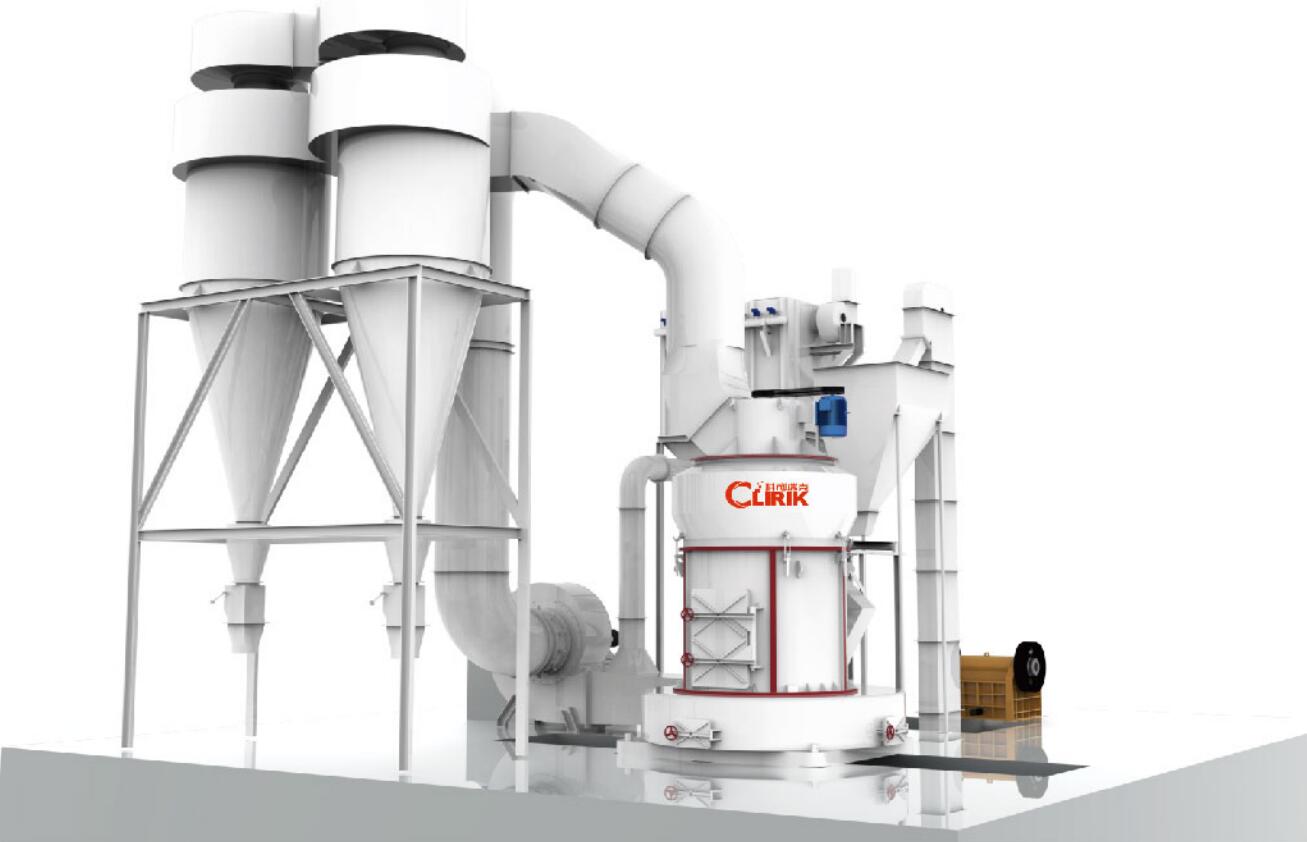
The high-pressure air blower is the part that controls finished PSD. The full closed loop includes grinding main unit, classifier, dust collector and so on.
Picture
\(d_{50c} \propto \frac{Q}{n^2}\) Q = classification zone air volume, n = rotor speed. Change speed or airflow and you change the cut size. This gives precise control over finished PSD.
1\ Higher speed: Stronger centrifugal force, smaller cut size. More mid-size particles go back for re-grinding. D50 and D97 drop. Fine fraction rises (D10 smaller). Distribution narrows. Mill circulating load goes up. Output goes down.
2\ Lower speed: Bigger cut size. Product gets coarser. D50 and D97 rise. Output improves. Coarse-particle tail widens.
1\ Higher airflow: Air carries bigger particles. Cut size rises. D50 increase. Product gets coarser. Output improves.
Too much airflow hurts classification accuracy, widens distribution and extends coarse tails.
2\ Lower airflow: Only finer particles get carried. D97 increase. Classification improves. Distribution narrows.
Tips: too little airflow causes material buildup in the chamber, bad running conditions and possible mill choking.
Higher feed rate: More particles in the chamber. They buffer each other. Grinding efficiency drops. More particles in the classifier cause interference.
Classification accuracy drops. D97 gets coarser. Distribution widens.
Lower feed rate: Lower concentration means better grinding and better classification. D97 drops. Distribution narrows.
Tips: Too low feed rate causes idle running, faster wear on rollers and rings, and wasted capacity.
Prioritize classification accuracy and coarse-particle control.
2\ Standard mass products (e.g., 325 mesh plastic filler GCC): Use "medium-low rotor speed + high airflow + high feed rate." Balance fineness and output.
HGM lines typically hold D50 ± 0.3 μm and D97 ± 0.8 μm batch to batch. This beats industry average and meets high-end supply chain needs.
Too fine D50 (< 2 μm) means high surface area, more coupling agent, higher melt viscosity, lower output and more agglomeration.
Standard film-grade masterbatch keeps D50 at 2–4 μm to keep balance.
·D97 effect:
D97 is the "lifeline" metric for film masterbatch.Some buyers also require D98 ≤ 12 μm.
When D97 exceeds film thickness, big particles do not fully melt into the polymer. They create crystal specks, fish-eyes and pinholes. These cause web breaks and full roll rejection.
Interior latex paints use D50 around 3–6 μm to balance cost and performance. Premium industrial topcoats use finer D50, around 2–3 μm.
Requirements vary by grade:
1\ ordinary interior latex D97 ≤ 12 μm;
2\ semi-gloss topcoats D97 ≤ 10 μm;
3\ high-grade automotive and furniture gloss paints need D97 ≤ 8 μm.
Finer D50 (1–2 μm) improves brightness and opacity. But fine particles escape with white water. Retention drops. You need more retention aid. Paper strength weakens.
D97 has moderate effect. Oversized particles create surface lumps and hurt printability. Standard filler GCC keeps D97 at 10–15 μm.
D97 over 8 μm means coarse particles scratch coating blades at high speed. This causes "blade streak" defects and missing print dots.
High-grade art paper and tobacco packaging coating GCC needs D97 ≤ 6 μm with narrow distribution.
1\ Laser diffraction (ISO 13320-1) is the industrial gold standard for PSD, especially for dry ultrafine powders.
2\ Closed-circuit grinding with forced centrifugal grinding — used in HGM ring roller mills — is the core technology for precise PSD control at 150-3000 mesh.
3\ Tuning PSD means balancing classifier speed, airflow and feed rate. Premium narrow products and high-volume standard products need different strategies.
4\ Different industries prioritize different PSD parameters. Better know your customer's application and match PSD accordingly.
Powder quality control has moved from rough "mesh count" to precise Particle Size Distribution (PSD) management.
Now the problem is many powder producers still do not understand PSD well. They rely on average particle size or a single mesh number. This causes quality disputes, low product prices and trouble getting into high-end supply chains.
This article explains PSD control on HGM ultrafine ring roller mills and shows real impacts across three downstream industries.
1.What Is Particle Size Distribution (PSD)?
1.1Definition & Types
PSD is a statistical description. It shows what share of particles in a powder sample fall into each size range.Real powder contains countless particles of different sizes. No single diameter can describe a whole batch. PSD uses statistics to map the full size composition.
PSD has three types based on what you count:
1\ Volume-based PSD:
This is the industry standard for mineral powders.Counts by particle volume share.Downstream formulas dose by mass or volume. Volume PSD links directly to filling efficiency and end-product performance. It is the default for ground calcium carbonate (GCC), calcite, talc and other fillers.
2\ Number-based PSD:
Counts by particle number.Used mostly for nanomaterials, aerosols and environmental monitoring.
3\ Area-based PSD:
Counts by particle surface area share.Used for catalysis, adsorption and pigment work where surface effects dominate.
PSD also has two display forms:
Differential (frequency) distribution:
Shows particle share in each size interval.Reveals peak shape and distribution width.
Cumulative distribution:
Shows total share of particles smaller than a given size.D10, D50 and D97 all come from this curve.
1.2Standard PSD Testing Methods
The powder industry uses several standardized test methods. Laser diffraction covers over 75% of industrial quality control measurements. It is the gold standard for powder grinding production lines like HGM ring roller mills.| Method | Suitable particle shapes | Size range of analyzed particles* | Analysis matrix | Method principle | Measured parameters |
| Laser diffraction (LD) | Spherical | 0.010 µm to 2000 µm | Dry powders or dispersions | Scattering/diffraction pattern | Equivalent spherical diameter |
| Dynamic light scattering (DLS) | Spherical | 0.3 nm to 10 μm | Dispersions | Brownian motion | Hydrodynamic size |
| Single particle optical sensing (SPOS) | Spherical | 0.5 µm to 400 µm | Dispersions | Light obscuration and/or light scattering | Equivalent spherical diameter, particle number concentration |
| Size and shape analyzer | All shapes | 2 to 3000 μm | Dispersions | Image analysis | Equivalent spherical diameter, length, width, aspect ratio, etc. |
| SEM | All shapes | > 10 nm | Dry powders | Image analysis | Diameter, width, length, aspect ratio; information about surface morphology |
| Mechanical sieve analysis | All shapes | 30 µm to 120 mm | Dry powders | Gravimetric analysis | Weight retained on each sieve |
| Air jet sieve analysis | All shapes | > 20 µm | Dry powders | Gravimetric analysis | Weight retained on the sieve |
1\ Laser Diffraction (Laser Particle Size Analyzer)
This method shines a parallel laser beam at dispersed powder. Different particle sizes scatter light at different angles. A ring of light sensors captures the scatter pattern. Math software rebuilds the full PSD curve.Range: 0.1 μm – 3 mm. (Covers nearly all ultrafine mineral powders.)
Pros: Fast (1–3 minutes per test), repeatable, outputs full PSD curves and all key diameters, works in dry or wet mode. HGM lines use dry laser analyzers for factory checks and in-process control.
Industry role: Dry laser diffraction volume results are the standard for GCC, calcite and petroleum coke preparation acceptance.
Sieving Method
It’s the oldest method. Standard test sieves separate powder fractions.You may weigh oversize and undersize material to get sieve residue.
Range: Coarse powders above 38 μm (400 mesh)
Limits: Only gives threshold data, no continuous curve. Ultrafine powders clog sieves and agglomerate, causing big errors. Only good for rough sorting, not precise PSD.
Sedimentation Method
Based on Stokes' law. You may measure how fast particles settle in liquid.You calculate equivalent diameter from settling speed.
It adapts two ways of examination: gravity and centrifugal.
Range: Submicron to tens of microns for high-density minerals
Limits: Slow tests, low sensitivity for narrow distributions, needs exact particle density and good dispersion. Mostly for lab comparison work, not fast production control.
Image Analysis Method
Takes photos of particles (optical microscope, SEM, or dynamic imaging). Measures size and shape directly from images.Limits: Counts too few particles for good statistics. Expensive equipment and labor. Only for shape observation and research, not batch quality control.
2.Why PSD Matters for Quality Control
2.1Average Particle Size Is Not Enough
Average particle size is a single number. Different calculation methods give different results: volume mean D[4,3], area mean D[3,2], number mean. Confusion over these causes quality problems.The big problem: one average number hides distribution width and coarse-particle tails. It can mask serious quality risks.
For example: two GCC batches both have a volume mean of 10 μm. Batch A is nearly uniform, particles between 8–12 μm, very narrow. Batch B mixes 90% 8 μm fine powder with 10% 28 μm coarse particles. Same average, totally different performance. Batch B's coarse particles cause coating defects and film pinholes. The average number never shows this.
2025 plastic filler data shows about 40% of filler quality disputes come from "average size passes but distribution fails." Just 1–3% oversized particles cause visible defects while barely moving the average. Relying only on average size leads to the classic failure: "lab test passes, customer rejects product."
2.2Single Mesh Count Is Also Not Enough
Mesh count means the number of sieve holes per inch. It is just a threshold. It tells you what share exceeds a certain size. It says nothing about the rest of the distribution.Three big problems:
1.Fails on ultrafine powder:
Below 1250 mesh (10 μm), sieve holes are tiny. Particles clump and clog sieves. Results are inconsistent.2.Loses too much information:
Two powders with the same sieve residue can have very different internal sizes. Two GCC samples both at 0.5% residue on 325 mesh can have D50 from 8 μm to 15 μm. Their filling and flow behavior differ a lot.3.Standards disagree:
Chinese GB/T 6003 and ASTM E11 use different mesh-to-aperture mappings. This causes confusion in international trade.2.3What Full PSD Analysis Brings
PSD gives complete size information from fine end to coarse end. You can pull multiple parameters, each linked to a different performance aspect. PSD is the "quality fingerprint" of powder:D10 (fine end): Links to specific surface area, oil absorption, agglomeration and reaction activity.
D50 (median): Links to overall fineness, filling efficiency, flowability and viscosity.
D97 (coarse end): Links to defect control, surface quality and wear resistance.
Distribution span: Span = (D90 – D10)/D50. Measures how wide or narrow the distribution is.
Manufacturers using precise PSD control can charge 15–30% more by serving high-end customized markets.
3.D10, D50, D97 Explained & PSD Control on HGM Lines
3.1What D10, D50 and D97 Mean?
In mineral powder work, D-values default to the cumulative volume curve. You start from the smallest particles and add up volume share. The diameter where cumulative volume hits a percentage is that percentage's D-value.·D10:
Diameter at 10% cumulative volume. Shows the fine-particle end.Lower D10 means more ultrafine particles, bigger surface area, higher oil absorption and more agglomeration.
·D50 (median):
Diameter at 50% cumulative volume. The main indicator of overall fineness.When people say "fineness," they usually mean D50. Note: D50 is a median, not an arithmetic average.
·D97:
Diameter at 97% cumulative volume. Shows the coarse-particle upper limit. Only 3% of particles are bigger.D97 is the most used coarse-end control metric. High-end apps may also require D98 or D100 (max size).
3.2How the HGM Air Classifier Works to Control PSD?
HGM ultrafine ring roller mills use completely sealed centrifugal grinding with high-pressure air blower classification. This is the mainstream technology for 150-3000 mesh ultrafine powder.Compared to ball mills use natural air classification. Separation is imprecise. PSD is wide. Coarse-particle content is high. They mostly handle products coarser than 400 mesh.
The high-pressure air blower is the part that controls finished PSD. The full closed loop includes grinding main unit, classifier, dust collector and so on.
Picture
- Raw material enters the grinding chamber( main unit ). Grinding rings and rollers crush it by compression and shear. Upward airflow carries ground material into the classifier.
- While operation, rollers inside the rings creates a stable centrifugal field. Particles here feel two opposite forces: interaction forces between raw materials and centrifugal force (flings outward toward the wall).
- When centrifugal force beats drag, coarse particles hit the classifier wall. They slow down, slide down the wall and go back to the grinding chamber for re-grinding.
- When drag beats centrifugal force, fine particles pass through rotor blade gaps. Airflow carries them to the pulse dust collector. They become finished product.
\(d_{50c} \propto \frac{Q}{n^2}\) Q = classification zone air volume, n = rotor speed. Change speed or airflow and you change the cut size. This gives precise control over finished PSD.
3.3How to Tune PSD on HGM Lines
Production uses three main parameters together: classifier rotor speed, system fan airflow and host feed rate. They interact. You balance them to hit target specs.Classifier Rotor Speed
Rotor speed is the main fineness control. It sets centrifugal force and cut size.1\ Higher speed: Stronger centrifugal force, smaller cut size. More mid-size particles go back for re-grinding. D50 and D97 drop. Fine fraction rises (D10 smaller). Distribution narrows. Mill circulating load goes up. Output goes down.
2\ Lower speed: Bigger cut size. Product gets coarser. D50 and D97 rise. Output improves. Coarse-particle tail widens.
High-pressure Air Blower System
Air blower system sets how much weight the air can carry and how fast air moves in the classifier. It also affects material transport inside the mill.1\ Higher airflow: Air carries bigger particles. Cut size rises. D50 increase. Product gets coarser. Output improves.
Too much airflow hurts classification accuracy, widens distribution and extends coarse tails.
2\ Lower airflow: Only finer particles get carried. D97 increase. Classification improves. Distribution narrows.
Tips: too little airflow causes material buildup in the chamber, bad running conditions and possible mill choking.
Host Feed Rate
Feed rate sets material output in the grinding chamber. It affects grinding efficiency and indirectly affects classification.Higher feed rate: More particles in the chamber. They buffer each other. Grinding efficiency drops. More particles in the classifier cause interference.
Classification accuracy drops. D97 gets coarser. Distribution widens.
Lower feed rate: Lower concentration means better grinding and better classification. D97 drops. Distribution narrows.
Tips: Too low feed rate causes idle running, faster wear on rollers and rings, and wasted capacity.
Production Tuning Rules
1\ High-end narrow-distribution products (e.g., 1250 mesh coating GCC with D97 ≤ 10 μm): Use "high rotor speed + moderate airflow + low feed rate."Prioritize classification accuracy and coarse-particle control.
2\ Standard mass products (e.g., 325 mesh plastic filler GCC): Use "medium-low rotor speed + high airflow + high feed rate." Balance fineness and output.
HGM lines typically hold D50 ± 0.3 μm and D97 ± 0.8 μm batch to batch. This beats industry average and meets high-end supply chain needs.
3.How PSD Affects Downstream Product Quality
4.1Plastic Filler Masterbatch & Biodegradable Plastics
The biodegradable plastics market grows 14.3% per year (Grand View Research, 2025). Filler PSD directly controls compound and mechanical performance.·D50 effect:
Too coarse D50 (> 8 μm) means low surface area, less coupling agent needed, good extrusion throughput. But mechanical strength and gloss drop.Too fine D50 (< 2 μm) means high surface area, more coupling agent, higher melt viscosity, lower output and more agglomeration.
Standard film-grade masterbatch keeps D50 at 2–4 μm to keep balance.
·D97 effect:
D97 is the "lifeline" metric for film masterbatch.Some buyers also require D98 ≤ 12 μm.
When D97 exceeds film thickness, big particles do not fully melt into the polymer. They create crystal specks, fish-eyes and pinholes. These cause web breaks and full roll rejection.
4.2Coatings (Latex, Industrial & Automotive Paints)
GCC, kaolin and other pigments affect film gloss, hiding power, texture and scrub resistance.·D50 effect:
D50 mainly controls oil absorption and optical properties. Finer D50 means more surface area and higher oil absorption. You need more binder, which costs more. But the film is smoother with better gloss and hiding.Interior latex paints use D50 around 3–6 μm to balance cost and performance. Premium industrial topcoats use finer D50, around 2–3 μm.
·D97 effect:
D97 controls film surface quality. Coarse particles create bumps. They also wear out spray nozzles and coating rollers.Requirements vary by grade:
1\ ordinary interior latex D97 ≤ 12 μm;
2\ semi-gloss topcoats D97 ≤ 10 μm;
3\ high-grade automotive and furniture gloss paints need D97 ≤ 8 μm.
4.3Paper Manufacturing (Filler & Coating GCC)
Within paper-grade calcium carbonate, PSD requirements differ a lot.·Wet-end filler GCC:
D50 affects brightness.Finer D50 (1–2 μm) improves brightness and opacity. But fine particles escape with white water. Retention drops. You need more retention aid. Paper strength weakens.
D97 has moderate effect. Oversized particles create surface lumps and hurt printability. Standard filler GCC keeps D97 at 10–15 μm.
·Coating-grade GCC:
Coated paper for high-end printing, D97 is the key metric.D97 over 8 μm means coarse particles scratch coating blades at high speed. This causes "blade streak" defects and missing print dots.
High-grade art paper and tobacco packaging coating GCC needs D97 ≤ 6 μm with narrow distribution.
4.Key Takeaways for Powder Manufacturers
PSD is more than a lab number. It is the quality fingerprint that sets product value, market position and customer satisfaction.1\ Laser diffraction (ISO 13320-1) is the industrial gold standard for PSD, especially for dry ultrafine powders.
2\ Closed-circuit grinding with forced centrifugal grinding — used in HGM ring roller mills — is the core technology for precise PSD control at 150-3000 mesh.
3\ Tuning PSD means balancing classifier speed, airflow and feed rate. Premium narrow products and high-volume standard products need different strategies.
4\ Different industries prioritize different PSD parameters. Better know your customer's application and match PSD accordingly.
FAQ
1.What does PSD stand for?
PSD means Particle Size Distribution. It describes the share of particles of different sizes in a powder sample. It is the most basic quality characteristic for mineral fillers and pigments.2.What are D10, D50 and D97?
They are characteristic diameters from the cumulative volume PSD curve. D50 is the median size. D10 shows the fine end. D97 shows the coarse tail. D97 is the most critical parameter for defect-sensitive applications.3.What is the best way to measure ultrafine mineral powder PSD?
Laser diffraction per ISO 13320-1 is the industry standard. It is fast, repeatable and outputs full PSD curves. HGM ultrafine lines use it for standard quality control.4.Why is average particle size not enough?
Average size is one number. It cannot show distribution width or coarse tails. A small share of oversized particles causes big defects while barely changing the average.5.How does an air classifier control PSD?
A high-speed rotor creates a centrifugal field. Coarse particles get flung out and sent back for re-grinding. Fine particles pass through with airflow. Changing rotor speed and airflow controls the cut size and the final PSD.6.What fineness can HGM ring roller mills produce?
HGM mills stably produce 150–2500 mesh powder with controllable PSD. High-end narrow-distribution products can hold D97 within ±0.8 μm.7.Why is D97 important for films and coatings?
D97 sets the coarse-particle upper limit. Even a small share of oversized particles causes film pinholes, coating scratches and surface quality loss. D97 directly controls defect rate and yield.8.Does PSD affect production cost?
Yes. Narrower PSD needs higher classifier speed and lower feed rate. Output drops but product value rises. Broader PSD allows higher output but limits product grade and price. Balancing PSD for cost and performance is key to profit.9.What is distribution span?
Span = (D90 – D10) / D50. It measures how wide or narrow the distribution is. Lower span means more uniform particles and usually higher product value.10.Is sieve mesh count reliable for ultrafine powder?
No. Below 1250 mesh, sieves clog and particles agglomerate. Results are unreliable. Mesh count only gives one threshold and cannot describe full PSD.Related Newsmore >>
- CLIRIK Mid-Autumn Festival 2026 Holiday Preview2026-09-07
- Oyster Shell HGM Ultrafine Mill for Circular Economy2026-09-04
- Particle Size Distribution (PSD) Technical Guide2026-09-03
- Ultrafine Grinding for Grain: Vortex Mill vs Jet Mill2026-09-03
- CLIRIK Welcomes Multiple Clients for Factory Visits2026-08-31
- Calcium Carbonate Grinding Mill: Equipment Iteration and Selection Logic2026-08-27